
Without Time-Consuming Effort,
Achieve Outstanding Results.
From glass and sapphire to ceramics, SiC, and resin materials,
BrillerMeule enables high removal rates with simple, stable processing across a wide range of materials.
“A process that took 2 hours now finishes in just 20 minutes.”

Electronic Component Materials | R&D Department
This was a development project for a new electronic component material.
With conventional loose-abrasive processing, each lot required nearly two hours of machining time, making evaluation slow and preventing a clear path toward mass production.
After switching from loose abrasives to BrillerMeule, the processing time was reduced to just 20 minutes per lot.
As a result, the decision was made to proceed with mass production, and the project quickly moved forward.
After implementation, the feedback was clear:

“Honestly, we wish we had consulted them much earlier.”
“Once lot-to-lot thickness variation was kept within ±5 μm, we could finally support mass production.”

Difficult-to-Machine Materials | Manufacturing Team Leader
At one production site, thickness variation exceeding 20 μm within batches and between lots was causing increased inspection and rework time.
After switching to BrillerMeule, results stabilized to:
・Within 2 μm inside a batch
・Within ±5 μm between lots
With reduced variation, yield improved significantly, and the internal decision was made that mass production was now feasible.
Moreover, the reduction in variation led to shorter final polishing times, contributing directly to cost reduction.
From the technical staff:

“We can now process with confidence.”
“Peace of mind knowing that the same results can be achieved—even when operators change.”

Resin Materials | Manufacturing Department
At one facility, changes in operators led to unstable processing quality.
Processing conditions relied heavily on individual experience, and it was difficult to ensure consistent results across different personnel.
When BrillerMeule was introduced, operating conditions were standardized and a clear management system was established.
As a result, any operator could achieve the same processing results.
Feedback from the production floor included:

“It’s reassuring to have someone we can consult with, and our process control has become much more reliable.”
Processing Time Improvement Case Studies
“Processing time reduced to one-sixth. The barrier from prototyping to mass production dropped dramatically.”
- At a certain electronic component manufacturer, machining a development product required more than two hours per process.
- After introducing BrillerMeule, processing time under the same conditions was reduced to just 20 minutes.
- This significantly accelerated evaluation and prototyping cycles, enabling earlier mass-production decisions.
“Processing time cut in half. Quality stabilized, and total cost improved.”
- In a single-crystal material processing line, long processing times and inconsistent surface quality were major challenges with conventional abrasives.
- By switching to BrillerMeule, processing time was reduced by approximately 50%.
- Stability improved as well, leading to a substantial reduction in dressing frequency and setup losses, contributing to overall cost efficiency.
“Sapphire and SiC were difficult to process efficiently—both rate and accuracy improved, enhancing quality.”
- In difficult-to-machine material applications, low removal rates and warpage correction were major challenges.
- After switching to BrillerMeule, processing time was reduced by about half, and by implementing warpage correction programs, dimensional accuracy was further improved.
Precision Improvement Case Studies
“Lot-to-lot thickness variation reduced to within ±5 μm. Yield improved and product value increased.”
- In a precision machining line, thickness variation within batches and between lots exceeded 20 μm.
- After implementation, results stabilized to within 2 μm inside a batch and within 10 μm between lots, reducing inspection and rework time.
- The reduction in variation also shortened end-user polishing time, contributing to cost reduction.
This improvement was highly valued and led to an increase in selling price.
“Surface burrs eliminated, improving downstream process efficiency.”
- In resin material processing, surface burrs occurred when using coarse grit sizes.
- Through optimized grit selection and processing conditions, surface quality improved significantly.
- As a result, cleaning and polishing process efficiency increased, reducing overall workload.
Reproducibility Improvement Case Studies
“Consistent quality achieved—even when operators change.”
- At one manufacturing site, frequent operator changes caused variation in processing results.
- During BrillerMeule implementation, processing conditions were standardized and documented.
- This enabled any operator to reproduce the same results, eliminating dependence on individual skill and supporting effective technology transfer.
“Stable processing even reduced the burden of lapping plate management.”
- Stable and smooth machining reduced processing resistance, eliminating workpiece vibration and abnormal noise.
- This also led to improved consistency in parallelism and surface roughness, and higher overall operational efficiency.
These outcomes reinforced the importance of stable processing, and customers also reported extended tool and plate life as an added benefit.
Cost Reduction Case Studies
“Multiple cost benefits achieved through BrillerMeule.”
By using BrillerMeule:
- Scrap was reduced
- Carrier and tool life was extended
- Industrial waste disposal and consumable costs were lowered
Additionally, improved surface roughness for difficult-to-machine materials reduced abrasive consumption in downstream processes.
These combined effects created a positive ripple effect, leading to significant overall cost improvements.
What Is the Fixed-Abrasive Tool “BrillerMeule”?
Sustained Processing Rate Enabled by a Fixed-Abrasive Structure
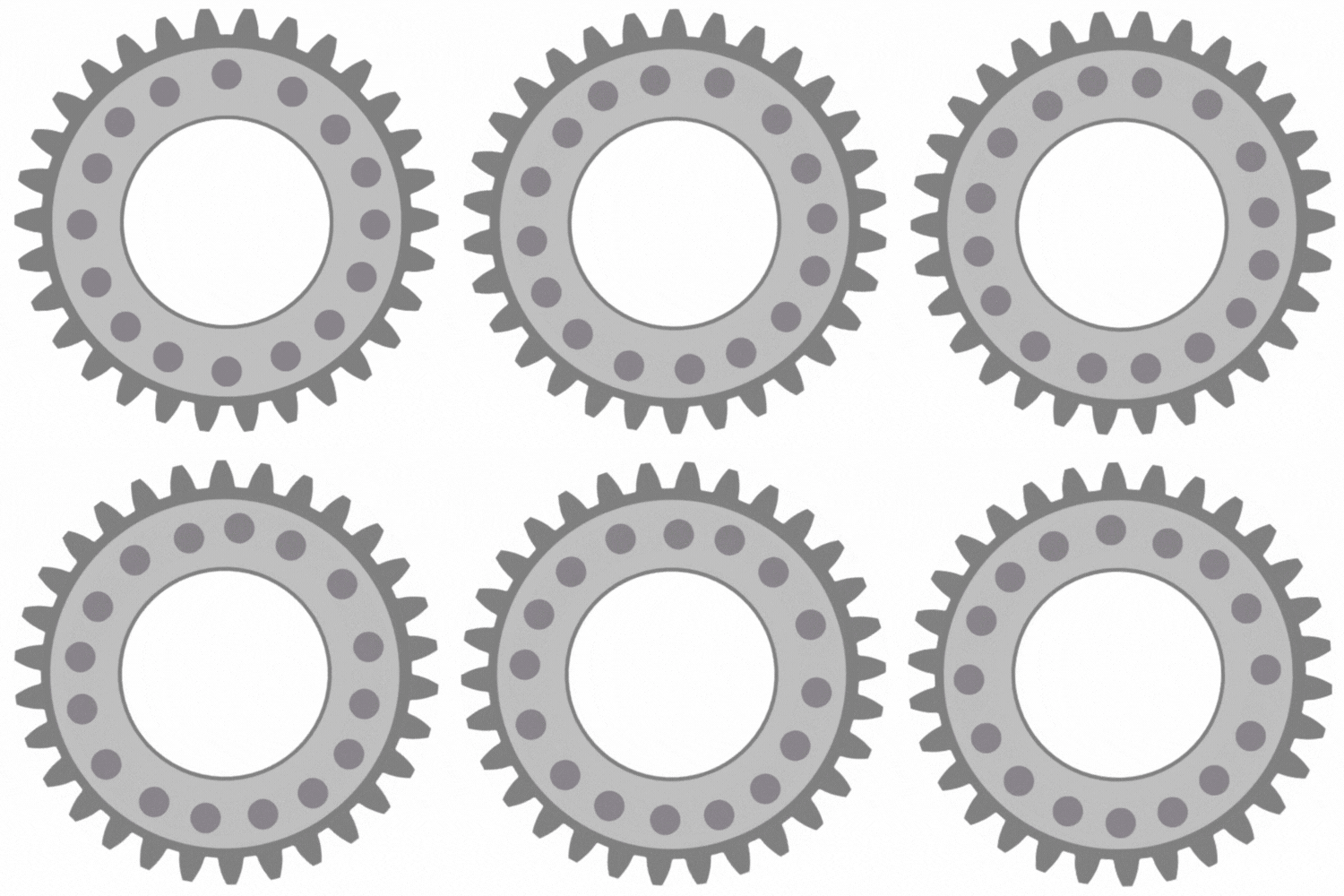
BrillerMeule features a structure in which diamond abrasives are firmly fixed within a metal bond.
Unlike loose abrasives, there is no concentration fluctuation, and the abrasives are designed to continuously self-sharpen during processing.
As a result, cutting performance remains consistent from start to finish.
This eliminates the need for dressing throughout the tool’s life cycle, allowing machining to be performed at maximum efficiency until end of life, leading to significant reductions in processing time.
Minimizing Variation Through Optimized Design
The DP abrasive pattern—including layout, density, and geometry—is custom-designed according to the material and workpiece size.
This uniformizes machining capability while suppressing vibration, uneven wear, and excessive processing resistance.
Improvements in parallelism and reductions in lot-to-lot variation are achieved through this rigorous design and evaluation methodology.
Achieving thickness variation within ±10 μm is the direct result of this optimized design and strict evaluation system.
High Reproducibility Through Standardized Processing Conditions
Processing parameters such as applied load, rotation speed, and abrasive grit size are standardized and databased for each material.
At implementation, conditions are set according to the objective—whether prioritizing removal rate or precision—enabling any operator to achieve the same results.
This approach eliminates dependence on individual skill levels, contributing to the removal of process variability and overall production line stability.
Optimized Combination Design of Patterns and Materials
BrillerMeule allows customization of abrasive patterns and bond materials according to workpiece shape, size, thickness, and material properties.
For example:
- Brittle bond materials are used for thin workpieces to prevent sticking
- Proven pattern designs are applied to minimize chipping
Proven pattern designs are applied to minimize chipping

High Operability with Magnetic Mounting and Segmented Tool Design
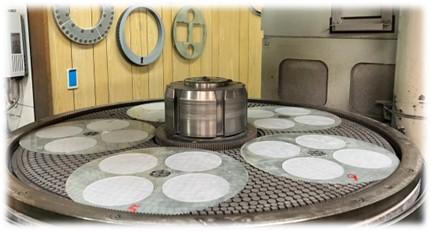
Thanks to its magnetic mounting system and segmented tool structure, safe tool replacement can be completed by a single operator in under 10 minutes.
With dedicated mounting jigs, tool replacement and reproducible machining can be performed easily and consistently by one person.
A single machine can handle multiple grit sizes and projects, making BrillerMeule ideal for high-mix, low-volume production and prototyping environments.
Frequently Asked Questions
Q: How often should the coolant be replaced?
A: If the coolant level decreases, it can be replenished and reused.
However, if a decline in processing or removal rate is observed, complete replacement is recommended.
Regular removal of swarf from the centrifuge helps maintain coolant stability.
Depending on processing conditions, there are cases where the coolant is used for more than one week without replacement.
Q; Can BrillerMeule be reused after reaching end of life?
A: Reuse of the BrillerMeule base after tool life is not recommended, as dimensional accuracy cannot be guaranteed.
However, repair services are available, so please feel free to contact us for consultation.
Q: How should BrillerMeule be cleaned and maintained?
A: If swarf remains on the DP abrasive surface or in the grooves, it may cause surface scratches.
After use, lightly rinse the tool with water using a shower to remove debris.
Note: Cleaning methods may vary depending on the bond material.
Q: Is BrillerMeule compatible with machines from any manufacturer?
A: Yes.
We confirm the platen size and coolant hole layout in advance and provide a custom-designed solution tailored to your requirements.
Q: Is there a risk of DP abrasive segments coming off?
A: Adhesion strength is verified through crash testing.
However, under extreme impact conditions, there is a possibility that segments may detach.
In such cases, repair is possible, but to avoid production downtime, we recommend keeping spare tools available.
Contact & Purchasing Information
For consultation on processing conditions, customization, or tool selection, please feel free to contact us.
Our specialists will support you with the optimal solution.